The Politics of Red Herrings…(The Halderman Report)
Bill Simon, September 16th, 2023
|
|
|
|

|
|
|
|
|
|
|
|
|
|
|

|
|
|
|

|
|
|
|
|
|
|
|
|
|
|
|
|
|
|
|
|
|
|
|
|
|
|
|
|
|
|
|
|
|
|
|
|
|
|
|
|
|
|
|
|
|
|
It’s too bad we don’t have a Time Machine of sorts in Ga GOP politics.
Because, if we did, and if the ambitious proposed amendments to the Rules of Georgia Republican Party are passed in the upcoming 2023 State Convention, perhaps we could go back in time to test the GRA’s theory of who the then-2021 state convention would have deemed to be worthy of passing muster to re-qualify as a Republican in 2022, and who would get the thumbs-down, and be blocked from qualifying as a Republican?
By the strangest coincidence, we do have a case, right here, right now, where we can test the GRA Theory of who is a Good Republican, who is a RINO Republican, and who is lower than dirt in the eyes of the GRA.
If you have read any of the e-missives from the likes of Alex Johnson or Nathaniel Darnell, you would read over and over their point of view on what they term the “political class” and how any member of it is lower than dirt in value to their Utopian view of the Ga GOP.
The AJC covered a bit of the GRA’s feelings about the “political class” in this article from March 23, 2023.
In it, they cite GRA President Alex Johnson’s message to his followers of urging the GRA to “send a message to ‘the political industry and their sycophants’ who blindly back establishment Republicans over ideological purists.”
I’ve received, and read, those GRA missives personally, so the AJC is summarizing things very well in that article.
Then there’s a mention about what happened at the Cobb County Republican Party convention, where there was an attempted move by Cobb RA Chair Nathaniel Darnell (frequent prevaricator and violator of Matthew 6, Verses 5-13) to kick Brittany Ellison off the delegate list to the state convention.
Ellison apparently won her slot in the end. But since Darnell didn’t win that round, he decided to bully her on the Cobb RA blog and falsely allege that she is a “liar” about what she dared to post previously about him (https://cobbgra.com/blog/ ).
And, he exhibited his derision for her being one of the “…paid members of the political industry.”
She is a “member” per se (as if that is a crime) as this is her company website. (But hold onto your horses, Folks…because this story is about to take a little turn…)
The “political class” are those people who are in the “evil political industry” whereby they derive income (Gasp! NO!) from the political and government world by being a political consultant, a lobbyist, a fundraiser, an events-planner, etc. who provide services to politicians for money.
In the mind of the GRA, anyone in the paid political industry is undeserving of any position of political party power, lest they use it for their own, personal gain (as if, ahem, the leaders of the GRA do not use their positions for self-aggrandizement purposes).
A couple of weeks ago, the GRA held a “Nominating Convention” whereby all evidence was brought forward on all potential candidates for State Ga GOP positions so the members of the Omniscient GRA could sit in judgement of qualifications. And decide, as a group, who they should nominate and endorse.
Let’s focus on just one candidate the GRA endorsed at their nominating convention. That nominee is for the next State Chair of the Republican Party: Josh McKoon.
McKoon is a former Georgia State Senator who is currently employed by the Technical College System of Georgia as their General Counsel, getting paid approximately $177,000 per year (Source: Open.Ga.Gov).
McKoon’s wife, Jacqueline McKoon, according to Josh McKoon’s campaign website: “…has an equal commitment to our cause and has a background in communications, advocacy, event planning, and foundation work. Together, we will ensure no facet of this organization is lacking.”
While that does sound like a wonderful background for Jacquelyn, what does it really mean?
A little bit of research revealed that Mrs. McKoon is the political consultant and president of “Constituent Connect, LLC.”
She discloses this on her Facebook page, so not too much work was involved in uncovering this.
What does Constituent Connect, LLC do?
Well, thanks to a little research into the two disclosure databases located at Ethics.Ga.Gov, we learn what Jacquie McKoon’s business entity has been doing since 2015 and up through 2023: CC has been paid political service consulting fees by 35 distinct Georgia-based politicians and political PACs.
In short, Constituent Connect, LLC is a political consulting company.
This fact makes Jacqueline McKoon a member of the “evil political industry” the GRA has been blasting about in quite the negative fashion.
I assembled the data into an easy-to-digest PDF report, showing details of all political clients and all payments paid to Jacqueline McKoon’s company from 2015 thru early this year. Constituent Connect Payments REPORT
For the years covering 2015 until now, her consulting company generated nearly $300,000 ($293,471 exactly) in total revenue from various Georgia political entities.
30 of those entities were Republican, 5 were Democrat political entities.
A few of the significant Democrat entities were:
A few of the significant Republican entities were:
It is the payments to Mrs. McKoon’s consulting from the Georgia Republican Party in recent years people should pay the closest attention.
Because the money she earned from being a political insider-friend of Chairman Shafer is money donated to the Ga GOP that was recycled into political consulting fees to Mrs. McKoon’s company.
AND then that money went into the Total McKoon Household Budget…where, when combined with Josh’s annual salary from the Technical College of Georgia, plus his pension from his time in the State Senate, all makes for a very nice sum of money that both McKoons derive from their mutual involvement in politics.
Then, there were candidates like then-candidate for Lieutenant Governor Burt Jones who paid Mrs. McKoon, and that money also went into the total McKoon Household Budget that personally benefited Josh.
Political consulting sure is a good business for the politically-connected, isn’t it?
And should Josh McKoon be elected in June to Ga GOP Chair, he will then be able to travel around the country to various RNC meetings on the State Party credit card dime, all the while making sure that every fellow politician he meets (or lobbyist, or PAC consultant, etc.) knows who his wife is, and what political consulting services she can provide all these new political contacts.
And, of course, ensuring that money from the Ga GOP gets directed towards Jacqueline’s company, the net cash flow of which will end-up in the McKoon Household Budget, where he will also derive benefits from awarding those contracts to his wife from the money he raises for the Ga GOP.
Josh will also be in a prime position as Ga GOP Chair to…thoughtfully suggest to any Republican candidates who meet with him to run for office in Georgia, that “Oh, by the way, my wife can probably help you…”
So, the prime GRA-endorsed Candidate for Ga GOP Chair, Josh McKoon, has a wife who is a working member of the “political industry.”
A paid political consultant. An evil political insider that people like Alex Johnson, Nathaniel Darnell, et al. despise because THEY are on the side of “Good” in the GRA.
Do either of the other two candidates for Ga GOP Chair have a spouse who is a political consultant, who will be in a key position of being exposed to all kinds of personal business opportunities that will result in both husband and wife being personally more financially-enriched due to the elected position of one of them?
I don’t think so…but maybe Rebecca Yardley and Dennis Futch can cover that aspect of their candidacy in the upcoming weeks of campaigning. What do their spouses do for a living?
As you can see, the GRA is quite incompetent in the simple “vetting” process of candidates for party office with regards to how it aligns with their supposed standards of Good vs. Evil.
And, if they are this incompetent in this little endeavor of a state convention party candidate vetting, just imagine how incompetent they will be if they succeed in the Rules change to then decide how “pure” someone is as a Republican to run under the Republican banner.
If they continue to sing the praises of Josh McKoon after this publication, they can be labeled as quite the hypocrites, just like the “RINOs” they deride in pretty much every single written publication they produce.
VAERS stands for: Vaccine Adverse Event Reporting System. The information is provided to the public on this Health and Human Services website: https://vaers.hhs.gov/data/datasets.html?
The VAERS database is supposed to be a source for reliable data on reported incidents of adverse effects for any vaccine. It’s just that this year, at this time, interest has cropped-up to put focus on the number of adverse events associated with the distribution of the Covid vaccines.
I’ve discovered the VAERS data to be compromised. Someone has tampered with it to remove 120,257 real records and replace them with some 120,257 fabricated records.
I know this because….they didn’t cover their tracks well at all. Here’s the proof:
The VAERS website provides Zipped data files in CSV format, available for download. This is the Zipped file I downloaded earlier this week (I have uploaded the file I downloaded from VAERS here: https://politicalvine.com/2021/covid/ because the data file changes every week as they selectively add the records they want to add)
In that zipped file are three separate CSV format files. The main file is titled “2021VAERSDATA.”
In that file are 406,001 records. You can find that out by opening the file I named above in Excel or Access.
The first field/column is called VAERS_ID. That field contains the unique record number of each record. This record number counts the number of records that are added…and for every new record entered, the count would advance by adding a “1” to the previous VAERS_ID number.
The dataset starts with the number 916600. (Numerically, that is 916,600)
If the VAERS database had integrity, the last record number would be on the order of 1322601 (i.e., 916,600 + 406,001)
BUT, that is not the last VAERS_ID Number. The last record number is actually 1442858 (1,442,858).
The difference between what should be the last VAERS_ID record number (1322601) and the actual number of 1442858 (1,442,858) is 120,257.
That means that the original dataset had 120,257 records removed, and 120,257 NEW RECORDS added of some unknown origin.
How many reported deaths do you think are in those missing 120,257 records? My guess is 120,257 deaths.
Adding that to the reported number of deaths on the HHS website on 7/15/2021 of 6,079, and the TOTAL deaths are really 126,336 in the USA due to the Covid vaccine.
The CDC and HHS has nothing but pathological liars in charge.
Have you noticed that they are now admitting I was right about everything they lied about before the election?
| Published June 2, 2021 by Save America PAC
Remain in Mexico, also known as MPP (Migrant Protection Protocols), was not only a historic foreign policy triumph but one of the most successful border security programs anyone has ever put into effect anywhere. Along with our Central America Safe Third agreements, asylum reforms, and expedited removal procedures we drove border numbers to record lows and we ENDED the horrendous practice known as Catch-and-Release. No American President had ever done more to defend the border and safeguard the whole immigration system. The Biden Administration inherited the most secure border in history, and they turned it into the greatest border disaster in history. Our border is now run by cartels, criminals, and coyotes. Illegal immigrants, gang members, and lethal drugs are pouring across like never before. Not only are illegal immigrants being caught and released, they are being put up in hotels at taxpayer expense. Our country is being destroyed before our very eyes. The Biden Administration’s disastrous decision to formally end the Remain in Mexico policy is proof that their objective is to eliminate the U.S. border entirely and flood the country with so many illegal aliens that every community is overwhelmed. Joe Biden is the first American President who doesn’t want America to be a nation at all. |
|
|
|
|
|
|
How much do you like being lied to?
It’s a serious question. It’s one thing to lie to yourself, as that is a voluntary act that you take on yourself. It’s quite another when someone you know, who is running for office and wants your vote…it should be a rather serious issue when someone chooses to deliberately, knowingly lie to you.
And, “That’s just politics, Bill” is hardly an acceptable condition. If “That’s just politics” has become your excuse for ignoring the lies from a candidate you decided to support, then don’t go preaching to me about your faith in God.
Recall Proverbs 12:22 – “Lying lips are an abomination to the Lord, But those who deal faithfully are His delight.”
The Many Dishonest Acts of David Shafer
I attended the 6th District Convention this past Saturday. I witnessed, and heard, David Shafer state a number of blatantly false things about his political history, some semi-ancient history, and some more current history.
Semi-Ancient History: From the stage, he made the following statement: “Right after I graduated college, I went to work as the Executive Director of the Party.”
Fact: No. He. Didn’t. But, making the statement he made would lead some to believe that he was soooo wonderful and smart of an individual that the State GOP at that time would have hired him as ED right out of college, doesn’t it?
According to this site, he graduated from UGA in 1988. According to this site, from 1989 through 1990, he worked for then-candidate for Insurance Commissioner, Billy Lovett, as Lovett’s campaign manager. Lovett had previously been a Democrat commissioner with the Georgia PSC. Lovett switched to the GOP sometime in the mid 1980s.
When Lovett lost in the 1990 November election, Lovett was asked in 1991 by the Republican party leaders of that time to become State GOP Chairman. Lovett accepted, and served from 1991 through until he retired from the party in 1995.
Shafer became ED under Lovett, and Shafer resigned from ED late in 1993, to work on the 1994 Guy Milner campaign for Governor. (For backup on that info, I found this archived document, written by my competition in the 2001 Chairman’s race, a time in which I actually did go to great lengths to support David Shafer for chairman when he ran against Ralph Reed.)
Why would Shafer skip over the simple fact that he worked for Billy Lovett? And, further, why does David Shafer like to claim he is apparently the sole reason Republicans got elected in the 1990s? On Saturday, he also alluded to his presence in the Party in the 1990s as being the reason why the GOP experienced significant gains then.
For the record, Senator Paul Coverdell was the first statewide Republican who won in the 1990s, as U.S. Senator in 1992. But, you never hear Shafer claim he’s responsible for that, do you? (He may after the issue of this Vine). It’s because he wasn’t, of course, just like he wasn’t responsible for the multiple wins in the 1990s by the U.S. Representative candidates.
The truth doesn’t, of course, ever stop Shafer from falsely embellishing that his mere presence as ED for the 2.5 years he was in that position, caused those wins to happen. Hard work by adults in the party is what won Congressional races in the 1990s, not then-Executive Director David Shafer.
Republican activists either don’t know, or like to overlook the fact, that the ED of the party is essentially an order-taker-and-follower. They work for the Chairman. They are not the pivotal person who decides strategy, who organizes the grassroots, who raises money for the party, who recruits candidates to run for office, etc. Chairman Billy Lovett did all that to bring forth GOP wins in the 1992-1994 election cycles.
But, Shafer has given the activists a very fine snow-job on his accomplishments…both in his earlier days with the party, and then, more recently. And, it’s the more recent history that is the most shocking to see him claim, whether on the stage, in print (as well as to read the idol-worshipping garbage Debbie Dooley* issues), that he says he’s responsible for accomplishing.
Recent History: Last Saturday at the 6th District Convention, Shafer also made this statement: “The SOS made that deal with the Democratic party in March [2020] without any input by the Georgia GOP.”
Well…that’s kinda factual, but you should then ask “Why wasn’t the Ga GOP involved in that case and decision?” The reason why the “deal” (i.e., Settlement Agreement) was made “without any input from the Georgia GOP…” was due to Shafer’s personal failure as Chairman to protect the Republican Voters of Georgia. It was 10,000% David Shafer’s fault, and no one else’s.
When Ann Lewis was alive, and she was the Ga GOP’s Legal Counsel, she made certain a Republican legal team was assembled, and ready to go for every major election. This included the monitoring of all case dockets (state and federal) so the legal team for the Party would know whenever an election case was being filed in Georgia, and they acted to intervene.
In 2019, when Shafer ran for Chairman the first time, he promised he would do the following in writing in his Campaign Plan:
“7. Strengthen Our Election Legal Team & Resources
“We cannot allow Stacey Abrams or the Far Left extremists to overturn the results of our free and fair elections. As your next Chairman, I will properly fund a team of our state’s best election attorneys and provide legal resources to defend our winning candidates.”
Shafer did not fund any team of election attorneys. In fact, when it was suggested to him to do so in early 2020, he flatly refused. And, look where his refusal got us. It got us steamrolled in the November 2020 election. His failure to follow through on his campaign promises are the reason why TRUMP LOST GEORGIA!
Even more troubling than not forming a legal team of capable Republican attorneys was Shafer’s decision to continue allowing Vince Russo, the lead lawyer for the Secretary of State’s office, the lawyer who personally negotiated the outside ballot boxes, the signature verification, etc….all the illegal things the Democrats wanted the State to implement…Shafer continued to allow him to be the legal counsel for the Georgia Republican Party! To this day, he is still legal counsel. W. T. _______???
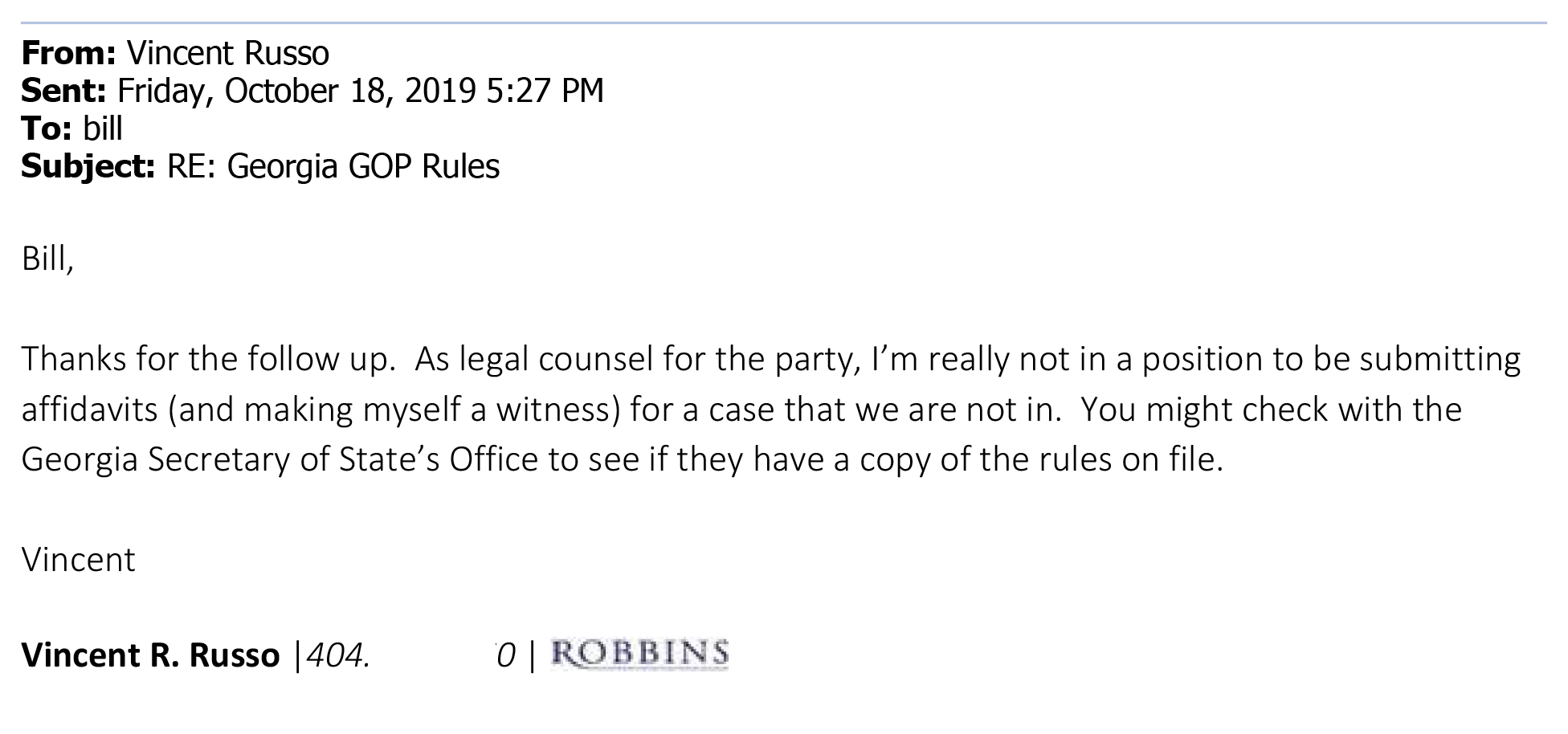
[In case Shafer claims Russo wasn’t involved in the Ga GOP until after the March 2020 Settlement, I have personal knowledge he was. On a completely unrelated matter, I had a conversation with Russo back in October 2019. This is the snippet of the email I received from him where he states he is the party’s “legal counsel.” So, he was acting as legal counsel since at least the Fall of 2019, and all during the case filed by Democrats against the SOS, and to this day, he still serves as “advising” Shafer and the Ga GOP.]
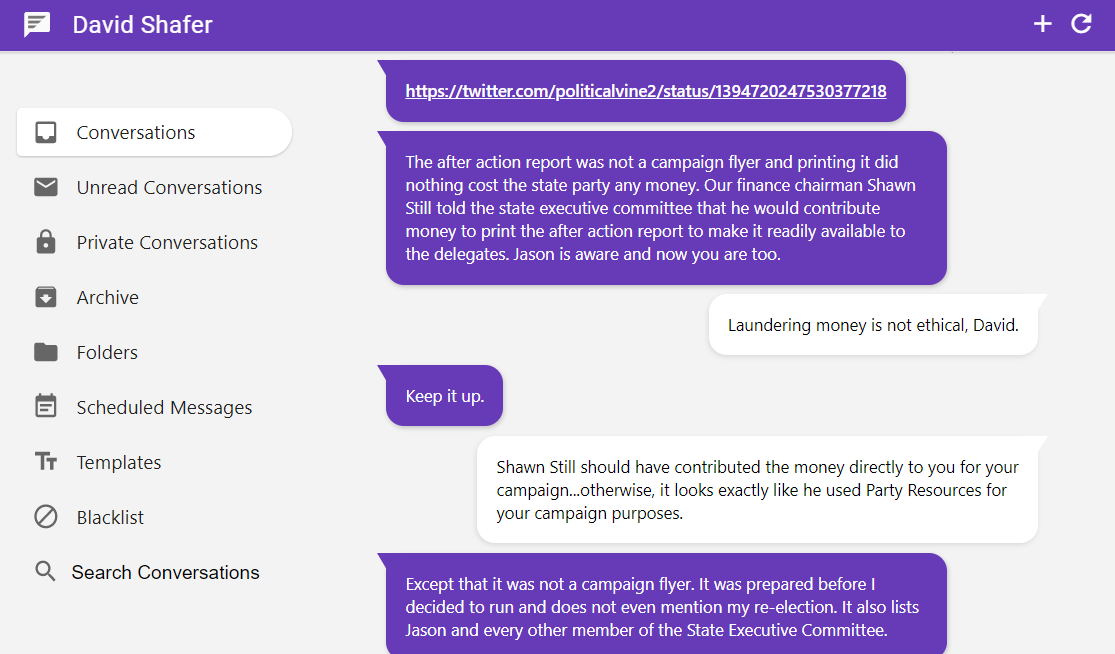
Now, the most recent thing is Shafer’s decision to use Ga GOP funds to pay for his personal campaign piece he is using to promote this candidacy for reelection as chair. This is Shafer’s M.O., actually, to never use his own money for things that benefit him, and cheat by using other people’s money.
I previously detailed Shafer’s multiple unethical acts of using his public office campaign funds in 2019 to pay for his race for GOP Chair. Though he claims he is “paying for his campaign expenses out of my own pocket” he is not. He is lying on that matter entirely as I have detailed with proof on this website.
But, to this current campaign piece: Here is a photo of the outside cover laid out. It is a booklet measuring 8″ x 10″. Inside is 16 pages of full color layout and printing of David Shafer claiming “Look at me! Look at everything I did! Worship me for my work!”, etc.
You saw this if you attended any District Convention this past weekend. Total pages are actually 18 (including front and back cover). On the back cover, it states “Paid for By Georgia Republican Party, Inc.” I estimate he likely purchased 10,000 copies. Ballpark, it could have cost the Party $2 to $5 per copy if you include all costs, graphic art design, printing, freight & sales tax in the purchase.
That means that Shafer made a deliberate decision to expend Party Funds in the amount of $20,000 to $50,000 for his personal campaign literature.
Now, if you are a sitting member of the Georgia GOP Executive Committee, or, running for an open position, and you see nothing wrong with the Chairman using state party campaign dollars for what is 100% a personal campaign puff piece for Shafer’s reelection, then you deserve to lose your election if you have an opponent.
Use of State GOP funds for a personal campaign piece is flagrantly wrong…and if you don’t think it is, then you are as unethical a person as David Shafer is, and you should not be serving in any capacity in a GOP office.
While the puff piece has a lot of claims and stats printed in it, based on my experience, and documented knowledge of who Shafer really is (i.e., he is a prolific liar and a cheat), I don’t believe all that is claimed in that 18 pages that Shafer claims happened during his tenure.
And, the fact that both he and Debbie Dooley are going to incredibly great lengths to promote him…well that is also a signal that he knows he is a fraud, and he has to over-compensate for his personal decisions that led to the Georgia Republican voters getting skunked in 2020, and on January 5, 2021.
Shafer claiming “I didn’t know that case against the SOS was happening” is not an acceptable excuse…because his decision to NOT have lawyers in place is a sign of a control freak whose ego deliberately led the Ga GOP over the cliff to lose the most important elections of our time. That’s not…smart. Reelecting him would be even dumber.
If he had just followed thru on his campaign promise to put a legal team in place, we would still own the U.S. Senate. A legal team would have known to monitor the case dockets, and they would have seen the case being filed by the Democrats in the Fall of 2019. A team of Ga GOP lawyers would have been able to put together the motions to file into the case and prevent people like Vince Russo and AG Chris Carr from negotiating away the protections of our election laws. But, Shafer thought he was smart enough to run the whole show himself…to the detriment of every Republican voter in Georgia.
Trump’s Support of Shafer
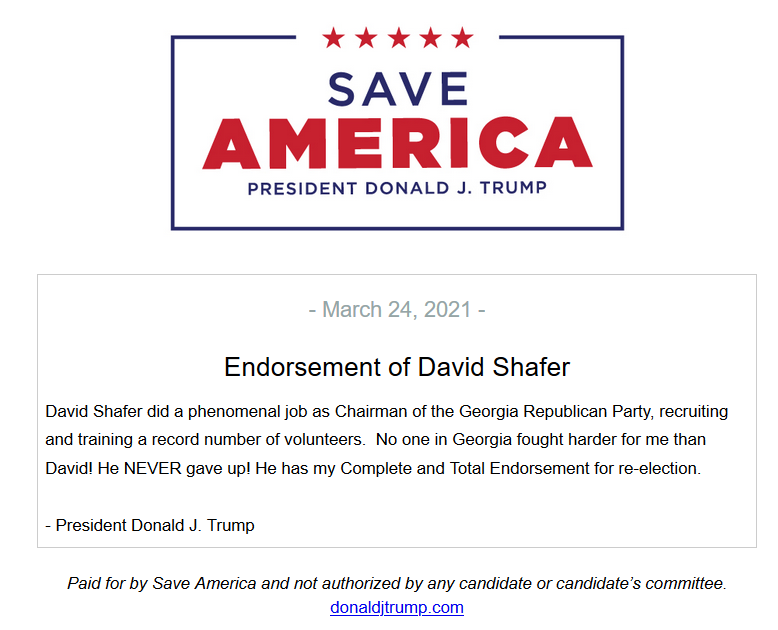
On the front cover of the Shafer puff piece is a statement by President Trump where Trump effusively supports Shafer. But, Trump does not know the real truth about Shafer, and his direct cause of his loss in Georgia by failing to have a legal team ready to go.
The truth is, Trump is operating off of bad advice, and bad information. And, for those of you who have a short memory of Trump’s previous hires during his administration that he hired due to bad advice from others, remember:
Jeff Sessions as AG
Rex Tillerson as Secretary of State
John Bolton as National Security Advisor
Jim “Mad Dog” Mattis as Defense Secretary
Anthony Scaramucci as Press Secretary
…and, many others…
So, for all of you who think that Trump is always making decisions based on good and valid information, refresh your memory of the above ^^^, please, and start thinking for yourself. Trump is surrounded by “Yes-men” and that’s all he knows.
The Georgia GOP will lose the state in 2022 if Shafer gets reelected as Ga GOP Chairman. Plain and Simple. Stop following this…”cult of personality” that is David Shafer.
Until next time…
*Does any Republican in Georgia have Al Gore’s Mobile Number other than Debbie Dooley? Just…curious if you think you want to follow whatever she claims to you…?
Preamble
There is a term in psychology called “projection.” There are various applications of it, but, in the context of this discussion, it has to do with someone spending a LOT of their time blaming others for their own faults and reckless negligence, in a deliberate attempt to duck responsibility for the FUBAR they, themselves, actually caused.
In a previous PV I issued a couple of weeks ago, I pointed out the repeated press releases issued by the Georgia GOP that attacked SOS Brad Raffensperger. Upon further research into a few things, I have come to the conclusion that, while Raffensperger does have his own faults (which I will get into shortly), the finger of whose fault it is for the resulting 2020 Settlement Agreement lies squarely at the feet of Chairman David Shafer.
Now, upon reading that, I know that Shafer (and his followers), will declare “That’s absurd! I didn’t know anything about the Settlement at that time! My (Party) General Counsel was forbidden to tell me!”
That was the defense uttered by Shafer’s Chief Useful Idiot, Debbie Dooley*, after the last PV was issued. This “defense” is based on the premise that a lawyer cannot divulge the matters of a case for one client to another client who is not a party to an ongoing case.
And, while that is true, as to confidentiality in an active case, the fact is that once the case got settled in early March of 2020, it was no longer a secret, and the facts of the settlement were published.
Here is an AJC article, describing the settlement, and look at the publication date of March 7, 2020.
Shafer’s Ga GOP has no excuse for not being prepared for the November 2020 election slaughter. None.
Here’s a fun fact, just to keep in the back of your mind: there were approximately 23,000 Republican voters who voted absentee in the June 9, 2020 Primary, who did not cast any vote in the November 3, 2020 election.
There was a component of the Settlement that allowed for anyone whose signature on an absentee ballot envelope that was rejected by a Board of Elections, had the opportunity to “cure” it by showing-up at their respective BOE, and showing their ID, and confirming their ballot was good and should be counted.
What did the Georgia GOP, under Chairman David Shafer, do, prior to General Election Day 2020, to prepare county parties on helping in the endeavor to contact any Republican voters in their county where the BOE had rejected their ballot due to a signature mis-match? Absolutely NOTHING. ZERO preparation.
The Democratic Party had their lines of communication all setup and ready to go. The Georgia GOP had NOTHING setup to notify Republican electors who may have gotten their ballots rejected due to a signature mismatch, and ZERO communication apparatus setup in the county GOP parties to remedy the “cure” issue.
What was the winning margin the Biden had over Trump in Georgia? About…12,000? How many Republican primary voters voted in June 2020 that didn’t vote in November 2020? About 23,000.
Golly…I wonder where the margin of difference could be buried? Could there have been 12,000 or so Republican absentee ballots that were not counted because they had a signature mismatch and were rejected in the various Boards of Election? Hmmm…
Lawyers, Legal Entities, and Shafer’s Reckless Negligence
I’m not a lawyer, and I’m not sure if there is a legal term of “reckless negligence,” but if there is, it would apply to Chairman David Shafer. Why? For his reckless negligence to the cause of defending and protecting the RIGHTS of the Republican voters in Georgia. How did he accomplish this? By him thinking he is smarter than 100+ years worth of legal precedent.
The Georgia Republican Party, Inc. is a legal entity, wholly separate from the State of Georgia, the Georgia Department of Law, and the Georgia Secretary of State.
The Georgia Republican Party should have a truly independent legal counsel advising it. Under Chairman Shafer, it did not. And that is 100% Shafer’s deliberate fault.
What is an “independent legal counsel?” A lawyer who has no client relationships with any other entity that could conflict with the party.
Shafer’s term as Ga GOP Chair began in May of 2019. In June of 2019, and continuing through 2020, Shafer’s GOP paid the law firm of Robbins, Ross et al. a monthly retainer to compensate Vince Russo as the Georgia Republican Party’s General Counsel.
You might recall seeing Vince Russo’s signature on the Settlement Agreement from March 2020. But his signature on that document was not because he was representing the Ga GOP. His signature was as defense lawyer in representation of the Georgia SOS’s office…a completely separate legal entity from the Georgia Republican Party, Inc. entity.
How much money does the State of Georgia pay Robbins, Ross et al. for lawyers like Vince Russo to represent agencies like the Georgia SOS? According to this snapshot of the Fiscal Year 2020, close to $1 million in pure legal fees:

On November 6, 2019, the Democrats filed the case against SOS Raffensperger that eventually turned into the Settlement Agreement. This is a link to the federal docket info for that case, where, when you open it, you can view all the Plaintiffs, all their lawyers, all the Defendants, and all their lawyers, as well as kinda follow the legal process of the case.
Note that there is no one representing the Georgia Republican Party, Inc. Note that the date of the filing was 11/6/2019…well into Chairman Shafer’s term as Chairman of the State GOP. Why didn’t the Georgia GOP have legal representation in there to intervene with our interests?
The Georgia GOP and Shafer cannot blame the Democrats OR SOS Raffensperger for his failure as GOP Chairman to hire a lawyer to represent the interests of the Georgia GOP in that case.
Why didn’t he hire someone to represent the Ga GOP to intervene?
If you ask him now, Shafer would likely claim “Well, Vince Russo was the Party’s Legal Counsel, and he’s getting paid by the State of Georgia to defend the SOS…and the SOS is a Republican, the Attorney General is a Republican, and I just saved a bunch of money for the Party by having state taxpayer dollars pay for our legal counsel to do double-duty.” Or, some such muddled line of thinking.
Did Vince Russo inform Chairman Shafer of the 11/2019 case, and that he would be representing the SOS in it? Shafer will likely claim Russo told him nothing, but, therein is the slight problem that Russo, as a lawyer, licensed by the State Bar of Georgia, has a higher level of requirements to follow than merely forgetting to tell his boss, Shafer, at the Ga GOP of his activities.
Georgia State Bar Rule 1.7 covers the instance of something called “Conflict of Interest” in which Russo was required to inform Shafer that he was representing the Georgia SOS’s office in an Election matter…and, when it comes to “election matters”, it damn well IS something the Ga GOP had better be getting involved in to protect our interests.
A lawyer who disobeys Rule 1.7 gets disbarred. (So, David, are you and your useful idiots going to continue to lie about your knowledge of the case the Democrats filed in November of 2019 to cover-up your blatant negligence? Make sure you do it in print so I can take that and file a bar complaint against Russo…because either you’re lying when you say you didn’t know anything about the case filed in November of 2019, or Russo violated bar rules and should be disbarred. These are the only two possibilities.)
Funny thing I just remembered about a conversation I once had with Shafer, back when he was Senator Shafer. I was mad at him for voting for some cluster-f**k legislation that expanded the government and decreased the liberty of the citizens, and his (paraphrased) response to me was: “Well, I got one side of the legislation from one lobbyist, and I got the other side of the legislation from another lobbyist, and I didn’t hear from anyone else.”
And, I asked him “Well, what about the actual people you represent? Did you think about the effect on them in this legislation?” He said “No, they weren’t there to tell me their concerns.”
So, just like back then, when Senator Shafer didn’t get input from, ultimately, the people most hurt by the legislation he helped pass, SOS Raffensperger didn’t hear from the Georgia GOP of their concerns for the proposed settlement changes in the law…and the settlement got signed, and the Georgia GOP was left with the crap that happened in the General Election of 2020.
Now…I happen to believe with…99.999% certainty that Vince Russo did inform Shafer, and Shafer, via the concept of “informed consent” (defined in Rule 1.7), allowed him to represent the SOS, and Shafer just blithely left the Ga GOP open to whatever the Democrats wanted to do. And, they gleefully got their revisions to the law in that Settlement Agreement.
But, through the psycho act of “projection,” Shafer lays ALL the blame on Raffensperger for the Settlement Agreement, when it was Shafer’s own deliberate, reckless negligence in failing to put together a true legal team, one independent of any other legal entity, whose interests didn’t conflict with the Ga GOP’s interests.
Character is Doing the Right Thing When Nobody Else Is Looking
In talking with a friend of mine recently, he told me that he attended the Fulton GOP Sunday Brunch Bunch a few weeks ago in which Shafer spoke to the crowd. In that speech, Shafer told everyone that (paraphrasing here) “After that March Settlement Agreement, I got the Georgia GOP to intervene in all the cases the Democrats filed after that time…”
Well, actually, that was a blatant lie Shafer stated to that crowd. Here are all the cases Democrat interests filed against the Secretary of State after that November 2019 case was settled in March of 2020…and you can look at the docket for each case…no appearance by the Georgia Republican Party, Inc. at all…not even a smidgeon as a party intervening:
Filed on 4-14-2020: https://politicalvine.com/wp-content/uploads/2021/04/FED-FileDate-4-14-2020.pdf
Filed on 4-20-2020: https://politicalvine.com/wp-content/uploads/2021/04/FED-FileDate-4-20-2020.pdf
Filed on 5-8-2020: https://politicalvine.com/wp-content/uploads/2021/04/FED-FileDate-5-8-2020.pdf
Ya know, for a guy to lie as much as Shafer lies, why would anyone trust him to remain in the position as State Chair?
Reckless Negligence, Part 2
While Shafer was guiding the State Executive Committee into getting riled up and attacking Raffensperger for things that Shafer was actually directly responsible for, do you know what the Democrats were doing in relation to the Election Integrity Bill wending thru the Legislature? I’m on their email list, and nearly every single day there was a blast from them claiming all the “evil” things (in their crooked minds) that the bill had in it.
Where was the State GOP to lend a hand in providing opposition cover to help the Ga GOP legislators? NOWHERE TO BE FOUND. NO press releases to fight the Democrats. Nothing issued by the Ga GOP to help communicate all the reasons for why the legislation was written as it was. Zero. No support AT ALL.
This is what you get when you have someone who is incompetent, who is negligent, who is a proven liar, who is lazy-minded in his approach to fortifying the legal interests of the party…you get two U.S. Senate seats lost, and Presidential Electors to send to D.C.
Now, is Brad Raffensperger a dirty, rotten POS? Yes, but not so much for the Settlement Agreement, as he is a POS for his defense of the many lies coming out of Jordan Fuch’s mouth and mind that Raffensperger allows to pass with no correction. People that look the other way for liars are sleazy people themselves (yeah, Brad, that’s you).
[Oh, and, Brad? You are also a sleazy SOS for your intervention, via that motion filed by the AG’s office, into the cases that Voter GA* has filed in both Fulton County court and Gwinnett County court, against those county boards of elections, for the examination of the absentee ballots. That move just proved you’re just as crooked as you can be about covering-up the ballot harvesting and stuffing that went on in this state in 2020.]
Side Note to the Reader: *VoterGA (Voters Organized for Trusted Election Results in Georgia) is a registered 501(c)(3) entity based in Georgia.
It has filed two lawsuits relating to the recent 2020 Georgia Elections: 1) Against Gwinnett County Board of Elections and 2) Against Fulton County Board of Elections.
The Fulton County case is being heard by a Henry County Judge and argued in Henry County (but Henry County’s BOE has not been sued).
Garland Favorito, the director of VoterGA, filed as the lead Plaintiff against the Fulton County BOE. This case is still on the Fulton County docket, which creates confusion when searching the Henry County website.
Here are videos of some of the proceedings thus far, courtesy of Ted Metz at Operation Educate:
VoterGA Motion For Summary Judgement in Gwinnett County Superior Court on March 24, 2021: https://www.youtube.com/watch?v=xq0uUIUveeA
Videos of Hearings for the Fulton County BOE Lawsuit: https://www.youtube.com/playlist?list=PLs-Naq5hayWv7W0lAeaexcNlWKDYmqhWx
Back to Shafer…his reckless negligence with respect to not having an independent legal counsel is actually WHY the State GOP didn’t intervene into the Voter GA cases. Because Voter GA is opposing the SOS’s office….and Russo gets more of his gravy from the State than he gets paid by the Georgia GOP…so, again, the Georgia GOP is hamstrung by the reckless negligence of David Shafer as chairman by not having adequate legal representation where it counts!
In Conclusion (for the moment)
While it is true that the Georgia GOP, in partnership with the RNC, is now intervening in the case(s) the Democrats are filing against the SOS and the State Elections Board over SB 202, Shafer didn’t think that up. He doesn’t have the mental capacity. The RNC Chairwoman took the lead on that initiative, and Shafer, as he always does, seeks to claim all the credit for it.
If you choose to ignore all the foregoing presented to you, as voters to the Ga GOP Convention this year (as some of you will because…you’re Shafer’s favorite Useful Idiots), I’d like to remind you of what Shafer said in his Campaign Plan when he was running in 2019. On Page 4 is this:
“During my tenure as Executive Director of the Georgia Republican Party in the early 1990s, I helped move Republicans from one congressman to eight in our delegation. The work we did laid the foundation for Republicans to move from minority to majority status in our State House and Senate.”
Well, let’s re-write that to describe our current condition, after two years of Shafer’s leadership as Chair:
“During my tenure as State Chairman of the Georgia Republican Party from 2019 until now, my decisions as leader directly led to Republicans losing both U.S. Senate seats, as well as the state’s electors for the Presidential Election of 2020.”
Yes, indeed…a glowing endorsement of his legacy, eh? And, you know the Democrats are actually hoping Shafer wins again as they thrive on incompetent opposition. Shafer hasn’t disappointed them at all these past two years.
[To follow more of Shafer’s idiocy as Chair, read part 4…]
*Speaking of Useful Idiot Debbie Dooley, Al Gore is one of her new buddies! Yes, and one has to presume that if the Green New Deal required every household to buy solar panels, she would be 100% in favor of the entire Deal! Here’s a riveting story to read…and read allllll the way down through the final paragraph. It’s delicious!
[If you landed on this article, and haven’t yet read Part 1, Part 2 will make far more sense if you read Part 1 first, link available here: https://politicalvine.com/how-to-guarantee-the-georgia-gop-loses-in-2022-beyond-part-1/]
INTRODUCTION
Turning our attention, now, to Shafer’s actual leadership of the Georgia GOP for the past 1.5 years, let’s take a gander at Shafer’s glossy 12-page “Plan” he/someone wrote-up for his 2019 campaign for GOP Chair, titled “Our Vision For Victory.”
On Page 3 of his 2019 plan is this: “If you elect me as State Chairman, I will roll up my sleeves and work by your side to carry Georgia for President Trump, re-elect Sen. David Perdue and recapture our lost seats in Congress and the General Assembly. I will get us back to the basics of grassroots organizing. I will make better use of technology to build our Party and communicate our message. And I will not rest until after Election Day 2020.”
Mmmmm….yes, those victories are soooo tasty in March of 2021, aren’t they?
Putting aside everything I presented in Part 1 about the Real Shafer, tell me, seriously, WHY are so many Republican activists so blindly gung-ho on electing Shafer again? His performance is ZIP! Nada! ZILCH!
A lot of his performance is not due to the Democrats and their efforts, both legal and illegal.
A lot of his failure to perform is due to the very same reason why an upstart State Rep named Geoff Duncan cleaned his clock in the 2018 race for Lieutenant Governor: David Shafer is LAZY-MINDED & he really does not care about winning.
With all his statewide recognition as a) State Senator for 12 or so years, and b) being Senate Pro Tempore for…6-8 years, and c) having a fundraising advantage, he should have been able to win on the FIRST BALLOT in the 2018 GOP Primary.
He didn’t win because he assumed he was a guaranteed walk-on. He assumed that because so many people in the GOP say they ‘love and revere’ him, that he assumed the entire population of Georgia Republican voters also loved and revered him, and the default choice was “Shafer.”
Frankly, he ran his campaign like a drunk attempts to solve Tic-Tac-Toe problems, drawing circles and X’s all over the page except in the slots they need to be placed.
For Shafer, that meant wasting a whole lot of money on unqualified campaign consultants, stupidly large expenditures on TV and Cable media, and very little money on building a grassroots campaign for LG to personally connect with voters.
So, come 2019…and the grassroots activists of the Georgia GOP decide, stupidly, to elect a proven LOSER in political campaigns to become State GOP Chairman.
The Beaver: “Golly, Wally, why didn’t the Georgia GOP do well in 2020?”
Wally: “Because, Beav, when those numb skull Republican activists elected a loser like Eddie Haskell to lead the party, there is nothing good that can ever come from that. He’s nothing but a conniving kiss-ass!”
So, let’s find out how Shafer brought his losing persona to lead the Georgia GOP to defeat in 2020…
Election Legal Team…
Quoting verbatim from the 2019 Shafer Plan is this section:
“7. Strengthen Our Election Legal Team & Resources
“Our opponents have lost at the ballot box but are trying to cheat their way into office through abusive litigation. They have regularly filed fraudulent claims to silence the voters of our state. In order to protect Georgia’s election results, we must build a strong legal team and guarantee ample resources are accessible for our candidates. So when Republicans win elections Democrats have no opportunity to overturn our results.
“We cannot allow Stacey Abrams or the Far Left extremists to overturn the results of our free and fair elections. As your next Chairman, I will properly fund a team of our state’s best election attorneys and provide legal resources to defend our winning candidates.”[emphasis added by me]
Guess…what? He didn’t fund any “team” of election lawyers. In fact, when it was brought up to him in mid-2020, he flatly refused to allow an election legal team to form for the MOST important election EVER in this state and country.
This I derived from reading this article online where Jason Shepherd, a lawyer who actually does know election law, provided this response in an interview: “…David Shafer had promised to build a legal team, in his own words, to keep the Democrats from stealing the election at the ballot box. By the time we hit the election we had no legal team built,” Shepherd said.” (PDF copy of that article is here, in case the article gets deleted: TheGeorgiaStarNews-Shafer-LegalTeam )
It is very clear to me, as I recall reading several published stories shortly after the November 3, 2020 election, that both the Trump Campaign & the State GOP were filing lawsuits in the WRONG legal jurisdictions! And that is why many of the lawsuits got rejected (hell, if just ONE lawsuit is thrown out because it was filed in the wrong jurisdiction, that is one too many).
That’s a lot of wasted time & opportunity to win a legal argument, whether an election-related one or not. There is a clock on every legal action that someone wants to file, and if you spend time on wasted efforts, your mistake costs people money…lives…and, yes, election outcomes.
Having a case rejected because it was not filed in the right venue is a demonstration of someone who is either a) legally incompetent, or b) an amateur (who can still be incompetent, especially if one walks around holding a license to practice law).
A “legal team” is necessary for these types of events because a “legal team” can work on issues in advance, and plan on how to answer problems that crop-up during an election…including how a Motion is to be worded and in what court jurisdiction a proper legal action can be filed.
So, without bothering to actually invest and implement the building of a “election year legal team,” Chairman David Shafer sat on his ass and LET THE Republican Party get steamrolled.
And yet, there are Facebook groups formed to support this incompetent, lazy-minded person to run the party again for two years. Those people are flat-out a combination of both stupid AND crazy.
Interestingly enough, they’re the same bunch of people who consistently voted for the lazy-ass John Padgett for state GOP chair in 2013 and 2015.
They’re also the same bunch of people who elected John Watson for state GOP chair in 2017.
This same bunch of people is the reason why Georgia is turning Blue. Because they have no common sense worth a crap when it comes to choosing party leadership. They operate off of emotional idiocy at a level that has no upper limits.
If David Shafer gets re-elected GOP Chair, y’all can kiss most of the Republicans getting reelected at the state constitutional office level goodbye.
And if AG Chris Carr gets defeated in 2022, whatever gains you folks THINK you will have gained through redistricting, it will all vanish with a Democratic AG…and our state will be a solid Blue in 2024.
But…what do I know? 😉
INTRODUCTION
Though the following quote has been attributed to Albert Einstein being the author, he may not have ever said it or written it (as I dug into the subject on the Web and came upon this guy’s research); nonetheless, the concept still means the same:
“Insanity is doing the same thing over and over again, but expecting different results.”
Insanity, Ladies & Gentlemen, would be the explanation for the Georgia GOP grassroots to choose to re-elect David Shafer for another term as Ga GOP State Chair. Why would that fit the definition of “insanity?”
Well, let’s look at the electoral results as an indicator: We lost TWO U.S. Senate seats in the same cycle, and we got blown out of the water by the Democratic Party’s proactive ground game by losing votes in the Presidential race, as well as losses of lower level Republican positions.
If you believe that all the losses are due to something SOS Brad Raffensperger and the State Board of Elections did back in March of 2020, I would say you have been sadly misled.
Many of the losses can be tracked right back to Shafer’s failures as Chair to follow thru on many critical things he promised he would do when he ran for chair in 2019. How do we know what he promised?
He had it on his 2019 campaign website. Here is a copy of his (copied here because things have a habit of disappearing when it comes to Shafer): ShaferBookFinal (I’ll discuss this in Part 2.)
In addition to several of his failures from his “Plan” being carried out to the detriment of the Georgia Republican Party’s performance in 2020-2021, I have recently discovered several disturbing things regarding Mr. Shafer and his campaign finances:
1) He deliberately misled (and probably continues to do so today) his grassroots supporters, and
2) He has possibly committed multiple violations of state campaign financing laws, the majority of which involve him deliberately, and knowingly, converting money from two of his public office campaign accounts to his personal financial use.
If ANY Democrat office holder, current or former, did what I will present to you that Mr. Shafer has done, you would be screaming for an “Ethics Investigation!” for that Democrat.
In fact, his violations of the law will be presented first because once you realize what a conniving snake he is, you will better grasp how he set the Ga GOP up for failure this past November 2020 and January 2021.
Shafer’s Ethical Lapses
Below is a snapshot of the top of Shafer’s Donation Page for his 2019 campaign for chair website:
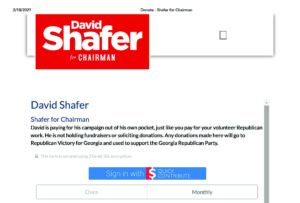
Note the wording below the ‘Shafer for Chairman’:
“David is paying for his campaign out of his own pocket, just like you pay for your volunteer Republican work. He is not holding fundraisers or soliciting donations. Any donations made here will go to Republican Victory for Georgia and used to support the Georgia Republican Party.”
What if you learned that NONE of his claim that he paid for his campaign “out of his own pocket” was true?
Further, what if you learned that “Republican Victory for Georgia” is a phantom organization that only exists in David Shafer’s mind, but Shafer actually claimed to the State Ethics Commission, in writing, that it is a viable legal entity? (Side Note: knowingly making False Statements, when made in campaign disclosures, are misdemeanors.)
It’s one thing to violate campaign finance laws (which is a pretty serious legal issue), but to actually contrive a claim that YOU are paying for Republican partisan activism out of your OWN pocket, and it turns out you’re lying about that, that should give any of you who are stalwart Shafer supporters pause to check your allegiance with him…and see if you are willing to continue following him over the cliff?
These are the facts:
In 2018, then-State Senator Shafer ran for Lieutenant Governor and lost in the primary run-off. This was actually the 2nd time he ran for LG. The first time was in the 2010 election, but that was a run that he did not complete because, you may recall, it was then-LG Casey Cagle who was going to run for Governor, but then decided to stay at LG. When Casey decided to not run for Governor, Shafer stopped running to replace him as LG, and remained a state senator.
I bring-up this little history because there are two campaign accounts that exist for Shafer’s two LG runs, both named exactly the same: “David Shafer For Georgia, Inc.”
How does one tell them apart for campaign accounting purposes? The Ethics Commission’s Reporting System assigns a unique “Filer ID Number” for each entity that registers and files disclosures. The first 4 digits of any FilerID# is the year the campaign registered with the Commission.
These are the three campaign legal entities Shafer has in relation to his various public offices:
2006-State Senate (Active)
David Shafer Senate Committee
FilerID#: C2006000189
2010-LG race (Terminated)
David Shafer for Georgia, Inc.
FilerID#: C2008000913
2018-LG race (Active)
David Shafer For Georgia, Inc.
FilerID#: C2017000292
[If you want to go exploring for all kinds of info about any state legislator or constitutional officer, you go here and look things up: https://ethics.ga.gov ]
Shafer has kept his State Senate campaign account in the Active Status, though he has failed to file his Campaign Disclosure that was due in January 2021. By his last filing made on June 30, 2020, he had almost $168,000 remaining in cash in that account (what did he do with that money for the 2nd half of 2020?).
Shafer has also kept his campaign account for his 2018 run for LG active, and as of his January 8, 2021 filing, he has cash on hand in the amount of $168,760.
He has filed Termination reports on his 2010-LG account back in 2018 (though the Disclosure System still registers that account as being “Active”).
As of early January 2019, all political activity for either the 2018 LG race or the termination of his serving as a State Senator should have legally come to a halt, because he was no longer an elected official, nor running for any public office.
As of the first part of January 2019, Shafer no longer held any public office position. Also, as we can see, he did not run for State Senate in 2020.
So, what can one do with one’s campaign funds if one has “excess contributions” and no race for publicly elected office?
Well, the State of Georgia actually has laws in place that directs every candidate for public office on what they can do with their money, and what they cannot do with those excess funds.
And, what is “public office” under the law? It is an office that has a state government-authorized election associated with that public office position.
OCGA 21-5-3 has all the legal definitions for learning what constitutes a “public officer” and what constitutes an “election.”
Election: (9) “Election” means a primary election; run-off election, either primary or general; special election; or general election. The term “election” also means a recall election.
AND
(22) “Public officer” means:
(A) Every constitutional officer;
(B) Every elected state official;
(C) The executive head of every state department or agency, whether elected or appointed;
(D) Each member of the General Assembly;
(E) The executive director of each state board, commission, council, or authority and the members thereof;
(F) Every elected county official and every elected member of a local board of education; and
(G) Every elected municipal official.”
So, when David Shafer ran to be State Chairman of the Georgia GOP in 2019, that position is not a position that fits the definition of “public office” in the State, nor was that a legally-recognized “election” for the purpose of being allowed to use campaign funds to try to get elected.
This is the law that stipulates what someone can do with their campaign contributions: OCGA 21-5-33. Disposition of contributions
On 5/8/2019, there was a $16,861.63 payment made to Rosetta Stone Communications, from David Shafer’s 2018 LG Campaign account. Weirdly, that is exactly 1 week before the May 15, 2019 State GOP Convention:
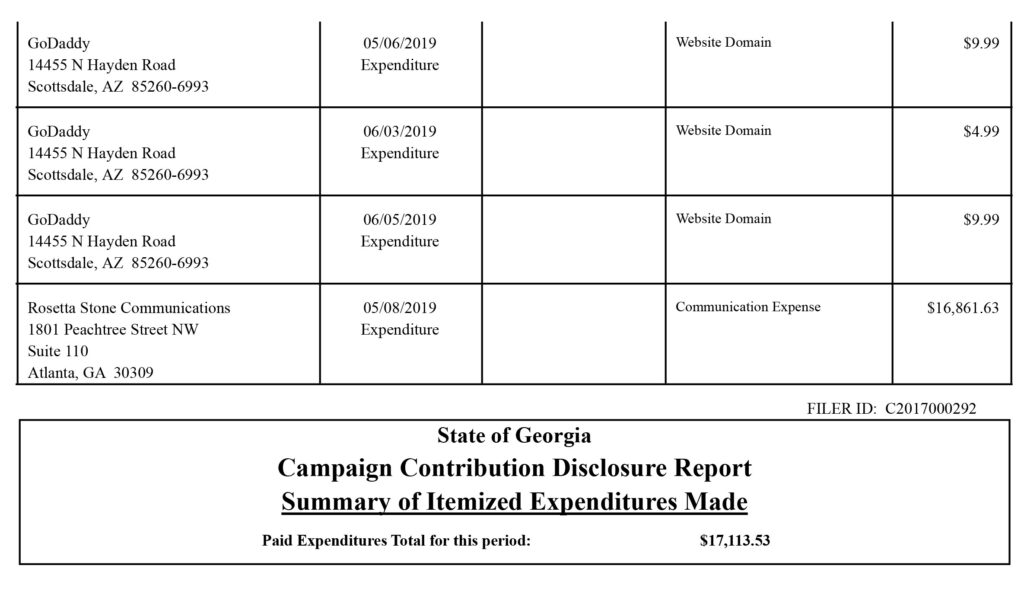
During Shafer’s 2018 campaign for LG, he did hire Rosetta Stone for several gigs:
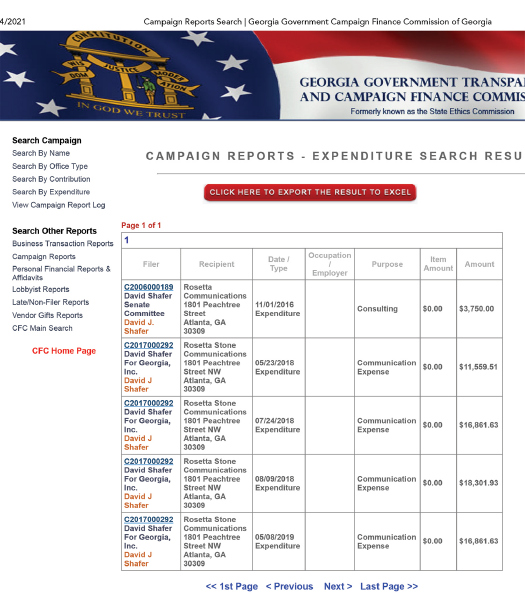
Oddly, an identical amount of money, $16,861.63, was previously paid to Rosetta Stone Communications back on 7/24/2018 for Shafer’s LG race.
How weird that “communications services” for two different sized races, 500,000+ voters in 2018 (for the run off against Duncan) vs. 3500 delegates in the 2019 GOP chairman’s race…cost the identical dollar amount. Really…odd.
Makes one wonder IF the May 2019 recorded expenditure was a real payment made to Rosetta, or was it a fabricated payment Shafer made to himself to hide what the money was actually used for? (Before you brush that off as “ridiculous,” read all the way down this article.)
Additionally, there are many other expenditures occurring from Shafer’s leaky LG campaign account, and, his active State Senate account, and in different ways, both appear to be used to support his candidacy for State GOP Chairman. This is a link to a PDF created by querying the Disclosures Database for all expenditures made after 1/1/2019 thru 2/28/2021 from any campaign account where the Candidate Name is “Shafer”: ShaferCampaignExpenditures-NoElection
I will publicly allege that several of these expenditures made after January 1, 2019, extending into 2020, paid directly from Shafer’s LG account & State Senate account, are illegal uses of campaign funds. And every time an illegal payment was made, that counts as a separate violation of the law.
But, don’t go away, there’s MORE to come!
Let’s revisit what Shafer has/had on his Donations page of his GOP Chairman Campaign website:
“David is paying for his campaign out of his own pocket, just like you pay for your volunteer Republican work. He is not holding fundraisers or soliciting donations. Any donations made here will go to Republican Victory for Georgia and used to support the Georgia Republican Party.”
Below is an extraction from Shafer’s 2019 June30 Senate Disclosure: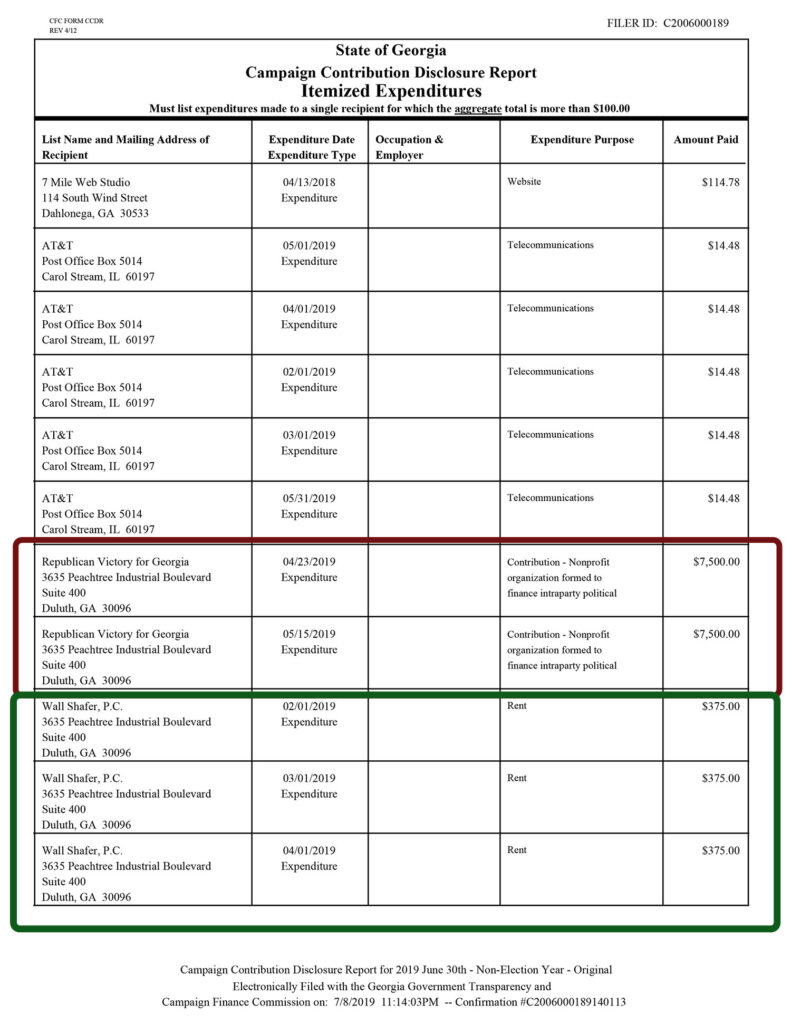
Note the two rectangular boxes: The top one, the red one, outlines two payments made from his State Senate campaign to an entity named “Republican Victory for Georgia,” totaling $15,000, right during the time period of his campaign for GOP State Chair.
Note the reason for the expense: “Contribution – Nonprofit organization formed to finance intraparty political”
Note the address of where the RVG entity resides:
3635 Peachtree Industrial Boulevard
Suite 400
Duluth, GA 30096
Note the name and address of the other entity on this page in which Shafer’s State Senate campaign paid “rent money” to: “Wall Shafer, P.C.” (Wall Shafer, P.C. is the law office for Shafer’s wife)
Wall Shafer has the same address as the “Victory” entity. Also, coincidentally, Shafer disclosed, via his last Financial Disclosure (SenatorShafer-2018-FinancialD) all these other entities he is associated with at that very same address: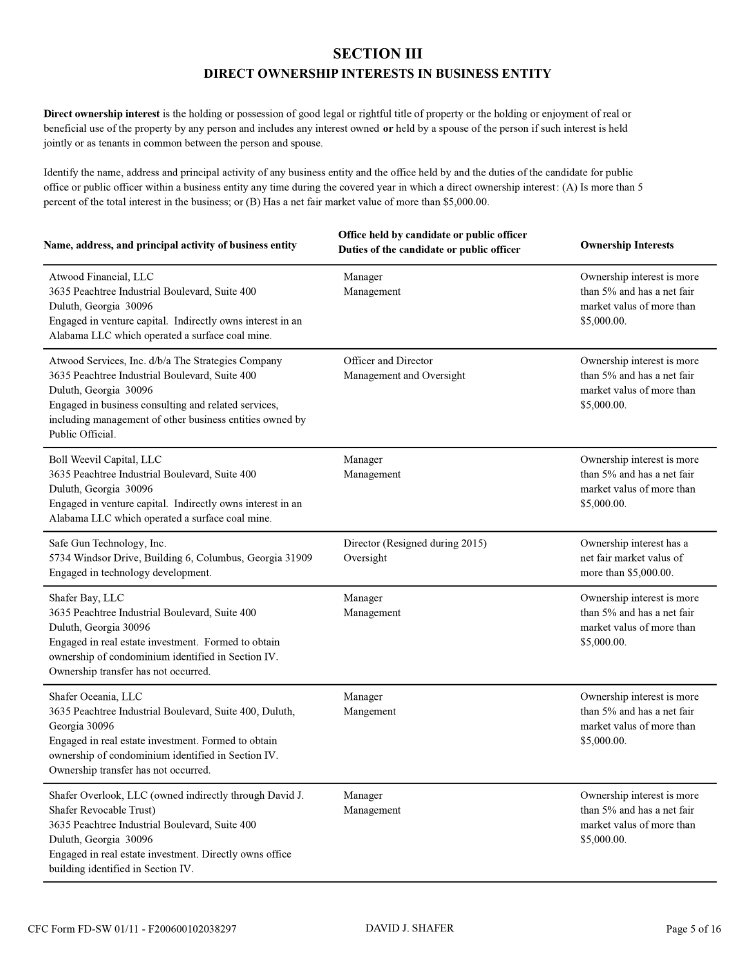
What is the ‘Republican Victory for Georgia?’
What an excellent question. Because…I searched the Georgia Secretary of State’s Website for all entities beginning with the word “Republican.” This entity is not listed anywhere on that list (Georgia-Legal-Entities-starting-with-Republican).
According to State Law on Campaign Expenditures, there is no mention of the phrase “intra-party political campaign” or related being an allowed entity in which excess contributions can be used to contribute money. The only mention relating to giving money to a non-profit is this part of the law:
OCGA 21-5-33 (a)(2)
“All contributions received by a campaign committee as provided in paragraph (1) of this subsection in excess of those necessary to defray expenses relative to the influencing of voters on such issue as determined by the campaign committee may only be used as follows:
“(A) Contributions to any charitable organization described in 26 U.S.C. 170(c) as such federal statute exists on March 1, 1986, and which additionally shall include educational, eleemosynary, and nonprofit organizations;”
I am certain Mr. Shafer (or his defense attorney for his impending ethics complaint) will proclaim that the Republican Victory for Georgia entity is a “nonprofit organization” and therefore Shafer is free and clear!
Not so fast, Home boy/girl…because…looking back to the “Definitions” part of the campaign contribution law, OCGA 21-5-3(17.2) defines what counts as a “nonprofit:”
“Nonprofit organization” means a corporation, foundation, or other legal entity, no part of the net earnings of which inures to the benefit of any private shareholder or individual holding an interest in such entity.
In the case of Mr. Shafer, and the physical address of the RVG entity being the exact same address as most of his other business entities, it doesn’t look like his RVG would pass the legal test on being a legal ‘nonprofit,’ authorized to accept $15,000 contributed from Shafer’s State Senate Campaign account. Because HE appears to be the only “private shareholder” of this entity (an entity I believe to be 100% fictitious).
And, going back to his campaign promise of “…Any donations made here will go to Republican Victory for Georgia and used to support the Georgia Republican Party.”…Well, in checking for ANY contributions to the Georgia Republican Party from ANY entity with the name “Victory” contained within it in the time period of concern, I could find no such contribution from any entity by the name of “Republican Victory for Georgia.”
In fact, if you click this link, I have embedded a query based on any occurrence of the word “Victory” in the Contributor’s Name slot, along with the Committee Name of the Recipient containing the word “Republican” and I bracketed the time frame to be from 1/1/2019 thru 2/28/2021, and the only entities fitting this are:
Georgia Victory Committee in Beverly, MA
Perdue Victory, Inc. in Atlanta, GA
Thompson Victory Group in Atlanta, GA
Trump Victory in Beverly, MA
Victory Public Affairs, LLC in Atlanta, GA
So, it is rather clear that he used his State Senate campaign coffers to enrich himself personally. He paid for some of his campaign for 2019 chair out of his LG account (and continues to pay from that account for many expenses unrelated to running for LG office), and he used campaign funds from the State Senate account for his own personal use (and also continues to tap those funds to pay for his personal business expenses, separate from campaigning for ANY public office).
There is no legal entity registered with the State of Georgia called “Republican Victory for Georgia.”
Also, there are no campaign disclosures for that RVG entity, “intraparty” or not. (Also, OCGA also has no such word as ‘intraparty’ in it, anywhere.)
So…those two payments, totaling $15,000, from his own State Senate account, paid to something at his own business address, look to be…how you sayyy…FAKE. Fraudulent. Fabricated. Fabricated so as to create the appearance of the payments being for legit, campaign purposes, but they were not legit at all.
And, fraudulent in that every time a campaign disclosure is filed, there is a statement at the bottom of the first page of every disclosure: “The electronic filing of this document constitutes an affirmation that the statement is true, complete, and correct.”
It’s not “correct” to use campaign funds for personal purposes. It’s not right. It’s not legal.
AND…again, he did not take money from his own pocket to pay for his activism. He’s not “just like you” of the Georgia Republican grassroots…he is a charlatan…he is a liar in that vein…Shafer is a conniver. He lied to each and every one of you when he claimed he’s ‘just like you, paying for things out of his own pocket.” Baloney.
He took money from his campaign funds and converted them to his own personal, unethical use, in supporting his run for a political party position. Campaign money is money from other people, not him. Not his “own pocket.”
Until my reading and researching this matter, and seeing how blatantly dishonest he is in using campaign funds for personal gain, I didn’t have concrete proof of just how shady, Shady Shafer really is.
That moniker (“Shady Shafer”), by the way, has been glued to him by others for over 20 years…and while I have been personally aware of his conniving ways…it’s been hard to prove it to anyone else, until now.
If you are curious as to how to file a State Ethics Complaint, there is a link below that will take you to the state government site, as well as I have done nearly all the work for someone to file by preparing the cover page you need to attach to the front of your complaint when you file (SHAFER-COMPLAINT-FORM)
How To File A State Ethics Complaint
https://ethics.ga.gov/complaints/
Rumors have it that the prime mover of the effort to incorporate a new “City of East Cobb” (“CEC”), a man named G Owen Brown, appears to be claiming Homestead Exemption Privilege in at least two states, rather than one, as allowed by law.
By “prime mover,” we mean the person who appears to have engaged in several activities to start the process for a CEC:
1) He registered the Corporate entity called Committee for Cityhood in East Cobb, (INC.) with the Georgia Secretary of State Corporations Division on September 4, 2018 under his name.
2) From a published story on EastCobbNews.com, the story cites sources that say Owen Brown paid for the majority of the $36,000 Feasibility Study (“FS”).
PV Sez: Now, for those of you who might raise voices and whine about why the Vine is going after just a guy who’s involved in an effort to incorporate a geographical area of a county into a city, it just happens to be a potential city located in Unincorporated East Cobb County…which is where we are based.
And, we have ZERO interest in adding another layer of government.
AND…a “city” actually constitutes the definition of what a “political subdivision“ is.
And, the incorporated entity advocating for an incorporation of a new city has taken the following steps:
a) Paid for a Feasibility Study, financed at least 85% by a single real estate developer
b) Hired a lobbyist specialized in campaigns to incorporate cities
c) Hired a political consultant to advise them on their activities
d) Gotten State Rep Matt Dollar to file a bill to incorporate East Cobb…a bill that has contained in it…
e) On Page 36, Lines 1096 to 1112, instructions to the Cobb County Elections Supervisor to set a date for election of cityhood to be whatever the date the Georgia SOS sets for the May 2020 General Primary.
SO, since the Cityhood entity, started by Owen Brown, is engaged in a political campaign to incorporate land area into new political subdivision, this is 100% a political matter.
And, FYI, every single person, or corporation, or association, involved, whether they have contributed money to the Cityhood legal entity or not, are involved in a political campaign. And, subject to the rules of engagement of political campaigns in Georgia.
But, back to the issue of Mr. Brown, and the vexing issues of why it weirdly appears 1) He is not a resident of Georgia, and 2) His and his wife’s names appear to be claiming Homestead Exemption on properties in both Ponte Vedra, Florida, and in Cobb County, Georgia.
Ponte Vedra is located in St. Johns County, Florida. In checking with that county’s property appraiser site, you can plug-in Mr. Brown’s name into the search bar, and come up with this current home owned by him and, presumably, his wife, Cheryl:
There are two ways we know this is G Owen Brown’s home: 1) His name on the record, and 2) if you read down the page to the record of Sale Information, the house was “sold” to them by an entity titled “PONTE VEDRA RESIDENTIAL PARTNERS LLLP.”
THAT LLLP is registered with the Georgia SOS to have existed at the 35 Johnson Ferry Road address…which is the identical address as RETAIL PLANNING CORPORATION (the company in East Cobb that Mr. Brown has been the CEO of for many years). This is the link to the LLLP record on the Ga SOS Website:
This is a link to the Active Status Record of Retail Planning Corp, which shows G Owen Brown to be the CEO….and that “35 Johnson Ferry Road” address:
So, that house in Ponte Vedra, Florida, is owned by G Owen Brown & Cheryl Casey Brown. And, if you look down the record, you will see a section that displays the following:
“Exemption Information
Exemption Type Amount
Partial Homestead $25,000
Partial Homestead Band $25,000″
In checking with the St. Johns County Property Appraiser’s office on what the meaning of “Partial Homestead” is, it is how the State of Florida grants multiple owners of a home the exemptions. Each owner living in a house gets, apparently, $25,000 in HE on their permanent home.
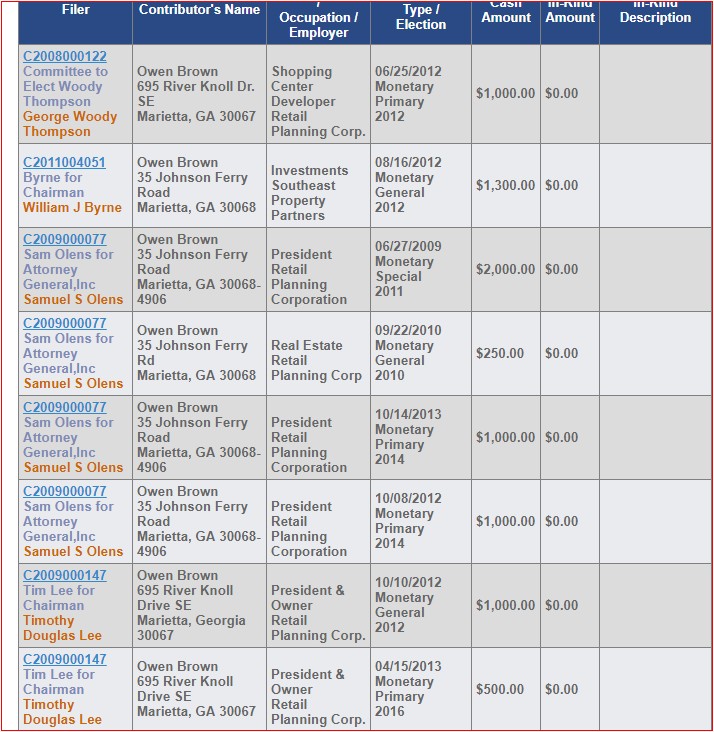
Anyway…let’s turn our attention to Georgia. In Georgia, through a search on the Ethics.Ga.Gov website section for campaign contributions made by “Owen Brown”, we took a snapshot that showed the address he currently lives at in East Cobb: 695 River Knoll Drive SE, Marietta 30067.
Taking this address, and going to the Cobb County Tax Assessor’s site online here, we discovered that there is a “Cheryl C Brown” whose name is on the River Knoll property as the owner.
Downloading the 2019 Assessment PDF from the Assessor’s site, we read that “Cheryl C Brown” has a Homestead Exemption declared for this address.
Now, to Mr. Brown, himself, in using that same Cobb County Tax Assessor’s site, but look up his name, we find an address located in another part of Cobb County that has the name “G OWEN BROWN” on the record as being a co-owner. This address is located at 511 HICKORY DR SW, MARIETTA GA 30064, as per this 2019 Assessment.
This 511 Hickory Drive SW address also has a Homestead Exemption claimed on it. Fancy that.
Well, that’s about all the info we have for the moment. Perhaps some enterprising folks with better research skills can develop more information based on what has been provided here…
I hope that someday we will be able to put away our fears and prejudices and just laugh at people.
| M | T | W | T | F | S | S |
|---|---|---|---|---|---|---|
| 1 | 2 | 3 | 4 | 5 | 6 | 7 |
| 8 | 9 | 10 | 11 | 12 | 13 | 14 |
| 15 | 16 | 17 | 18 | 19 | 20 | 21 |
| 22 | 23 | 24 | 25 | 26 | 27 | 28 |
| 29 | 30 | |||||